
TimberLAND

<October 8, 2026>
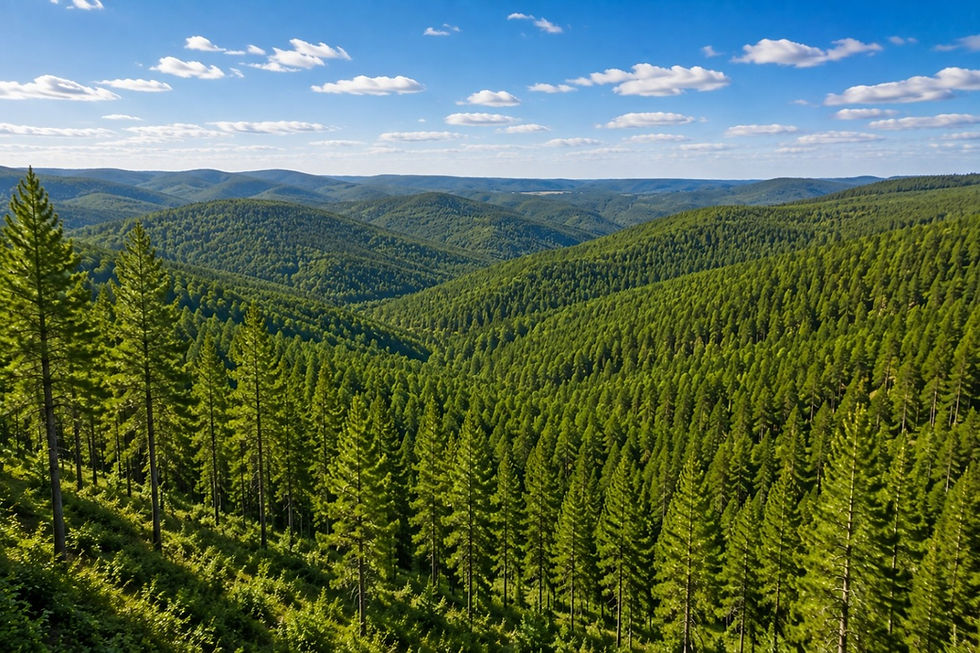
Approximately fifteen years ago, I was talking with my analyst about the timberland company Potlatch. To make a point about its attractive valuation, I asked, “What would you rather have, an acre of timberland or $1,000?”
He replied, “$1,000. I’m broke!”
I was never the best teacher.
As of September 30, 2026, the Palm Valley Capital Fund held shares of Rayonier (symbol: RYN). Rayonier is a timberland REIT that owns approximately 4 million acres of timberland in the Southeast and Northwest. Our path to owning Rayonier began several years ago.
We believe the stock market, in aggregate, is extremely expensive and that the leading drivers of the current market and profit cycle are artificial and unsustainable. Rather than go with the flow and purchase equities we believe are overvalued, we’ve held a meaningful position in cash and Treasury bills. As of September 30, 2026, the Palm Valley Capital Fund had 75.5% of its assets invested in cash and cash equivalents.
While we believe cash will hold its value in nominal terms, inflation poses a risk to its value in real terms. Based on the government’s inflation data and current interest rates, Treasury bills and money market funds currently offer a positive real return. However, as we’ve learned throughout much of this cycle, the Fed can abruptly pivot, cut rates, and aggressively expand its balance sheet—threatening real returns. There is also the possibility that inflation is understated, meaning what appears to be a positive real return may be an illusion.
To protect against the risk of negative real rates, we’ve invested a portion of the portfolio in asset-heavy businesses and other hard assets that we believe can serve as effective inflation hedges.
During COVID, silver collapsed from approximately $18 in early 2020 to a low of $11.64 on March 20, 2020. With silver trading below our calculated cost of production and interest rates in sharp decline, we took our initial position in April 2020. We eventually did the same with gold, establishing our first position in February 2021. With real interest rates negative and companies raising prices, we took comfort in owning gold and silver.
As inflation surged and the Federal Reserve remained extraordinarily easy, precious metals began to catch a bid. With consumer prices continuing to rise, it became increasingly clear that the Fed was unwilling to take the painful but necessary actions to fight inflation. Eventually, gold exceeded $5,000 an ounce and silver $120 an ounce. While we didn’t sell at the top, we gradually reduced our positions as prices climbed, ultimately exiting silver in December 2025 and gold in January 2026.
It was pleasing to see our inflation hedge work as intended, but it didn’t take long for us to feel seller’s remorse. The feeling was difficult to explain, but with the metals gone, we felt uneasy without designated inflation fighters in the portfolio. In effect, we felt exposed, and our search for a hard-asset replacement intensified.
Although the prices of many inflation hedges and asset-heavy businesses had already risen, one sector remained out of favor—timberland. The two remaining timberland REITs, Weyerhaeuser and Rayonier, have both suffered double-digit declines in 2026. Their returns over the past five years have also been negative.

Interestingly, while the stocks of the timberland REITs have performed poorly, the value of their underlying timberland has continued to appreciate, outpacing inflation.

Although timberland has protected investors from inflation over the past decade, it has considerably lagged other hard assets such as precious metals. Timberland hasn’t had its “hockey stick” moment like some other inflation-fighting assets and commodities.


Timberland and timberland REITs have lagged precious metals for valid reasons. The sharp increase in home prices, rising mortgage rates, and other ownership costs have created an affordability crisis and contributed to a sharp decline in new and existing home sales. The housing market has been in a slump for more than three years.


When it comes to housing, it’s important to distinguish between price and activity. Based on price, housing is in a boom, or maybe even a bubble. Based on activity, housing is in a bust, or maybe even a recession. With housing activity well below its 2021-2022 mini-boom, demand for lumber and sawlogs has remained weak.

Demand and prices for pulpwood have also been weak. Pulp and paper mill closures in the South have been particularly troublesome. The Wall Street Journal reported that 10% of U.S. containerboard capacity was lost last year. While weak pulp prices have hurt the operating results of the timberland REITs, pulpwood represents a relatively small percentage of total sales (8% for Rayonier).
Even with depressed housing and pulp markets, Rayonier generated $218 million in adjusted EBITDA and $177 million in cash available for distribution (CAD) during the first half of 2026. Based on its recent results, and assuming the challenging operating environment doesn’t worsen, we expect Rayonier’s profitability and cash flow to be sufficient to cover its $0.26/share quarterly dividend, which currently yields 5.7%.
The timberland REITs have been taking advantage of the rising value of their acreage by selling land for its highest and best use (HBU). Land used for recreation, carbon capture, solar farms, and other development can command prices far above traditional timberland values.
For example, in Q2 2026, Rayonier’s real estate division generated $53.7 million in sales and $28.3 million in operating income, representing 44% of total company EBIT. During the quarter, it sold 7,490 acres of rural land at an average price of $5,439 per acre, including a 459-acre sale to a solar developer for $10,100 per acre. By comparison, NCREIF data values Southern timberland at approximately $2,300 per acre.
We view the timberland REITs as investments in land. Whether that land is used for timber, solar farms, recreation, or development, we are indifferent. We believe the trend of monetizing acreage for higher and better uses will continue and expect the percentage of land used for timber and pulp production to slowly decline over time.

In our opinion, the current stock market and profit cycle have been driven by enormous amounts of deficit spending and debt. As debt continues to swell, the bond market is showing signs of revolt. With interest rates rising across the yield curve and capital needs increasing, we believe policymakers will eventually be forced to choose between inflation and other unattractive alternatives, such as deflation, declining GDP, or default. Based on their past actions during crises, we’re confident they’ll choose inflation.
With this cycle’s end game in mind, we are interested in owning hard assets. And with timberland REITs currently shunned by investors, we find the value and inflation-fighting capability of their land compelling. At $18 per share, Rayonier’s 4 million acres of Southern and Northwest timberland are valued at approximately $1,700 per acre, including debt.
This is well below the market value of its timberland, let alone acreage that can be sold for higher and better uses. Rayonier’s current valuation also assigns no value to its Wood Products division (six sawmills), which generated $31.8 million in EBITDA during the first half of 2026 and has a history of occasionally producing windfall returns.
The timberland REITs are out of favor, there are risks, and it may take time for our investment thesis to work. But with inflation, spending, and debt all refusing to yield, would we rather have $1,700 or an acre of timberland?
We’ll take the land!
Eric Cinnamond
The Palm Valley Capital Fund can be purchased directly from U.S. Bank or through these fund platforms.
Index performance is not indicative of a fund’s performance. It is not possible to invest directly in an index. Past performance does not guarantee future results. Current performance of the Fund can be obtained by calling 904-747-2345.
There is no guarantee that a particular investment strategy will be successful. Opinions expressed are subject to change at any time, are not guaranteed, and should not be considered investment advice.
Fund holdings and allocations are subject to change and are not recommendations to buy or sell any security. Current and future portfolio holdings are subject to risk. Click here for the fund’s Top 10 holdings.
Mutual fund investing involves risk. Principal loss is possible. The Palm Valley Capital Fund invests in smaller sized companies, which involve additional risks such as limited liquidity and greater volatility than large capitalization companies. The ability of the Fund to meet its investment objective may be limited to the extent it holds assets in cash (or cash equivalents) or is otherwise uninvested.
Before investing in the Palm Valley Capital Fund, you should carefully consider the Fund’s investment objectives, risks, charges, and expenses. The Prospectus or summary prospectus contains this and other important information and it may be obtained by calling 904 -747-2345. Please read the Prospectus or summary prospectus carefully before investing.
The Palm Valley Capital Fund is distributed by Quasar Distributors, LLC.
Definitions:
REIT: (Real Estate Investment Trust) is a company that owns, operates, or finances income-producing real estate and allows investors to invest in real estate through shares, similar to investing in stocks.
Real rates: interest rates adjusted for inflation. They measure the true increase in purchasing power from lending or investing money.
Real returns: investment returns adjusted for inflation. They show how much an investment actually increased your purchasing power.
Hard assets: tangible, physical assets that have intrinsic value and can often help preserve purchasing power during inflation.
NCREIF: the National Council of Real Estate Investment Fiduciaries—tracks institutional timberland investment performance through the NCREIF Timberland Index (NTI).
PGIM: a global investment management business of Prudential Financial, Inc. It is a large institutional asset manager investing across public and private markets, including fixed income, equities, private credit, real estate, infrastructure, agriculture, and timberland.
CPI (Consumer Price Index): is a measure of the average change over time in the prices paid by consumers for a representative basket of goods and services.
EBITDA: Earnings Before Interest, Taxes, Depreciation, and Amortization. It is a measure of a company's operating profitability before financing costs, taxes, and certain non-cash accounting expenses.
EBIT: Earnings Before Interest and Taxes. It measures a company’s operating profit after operating expenses, including depreciation and amortization, but before interest expense and income taxes.


Comments